The Uncanny
House of LeavesThe Uncanny is the book’s central term for the transformation of familiarity into estrangement. Its German analogue, unheimlich, carries the double force of the “unhomely” and the “dreadful”: what should provide shelter becomes too large, too indefinite, and too exposed to remain protective. The concept therefore describes not merely fear, but the collapse of the ordinary conditions that allow people to feel situated in the world. The Navidson house on Ash Tree Lane becomes its decisive architectural embodiment.
Definition and Philosophical Background
The discussion begins with the German word unheimlich and Martin Heidegger’s treatment of anxiety in Sein und Zeit. In the cited translation, anxiety makes one feel uncanny because the world no longer offers a determinate object or location; what emerges is the “nothing and nowhere.” Uncanniness also means “not—being—at home.” Heidegger’s contrast is between everyday familiarity, in which existence settles into an apparently secure public world, and anxiety, which pulls existence out of that absorbed routine and returns it to an individualized, unsettled condition.
This account makes the uncanny a disturbance of being-in-the-world rather than a simple reaction to a frightening object. Ordinary familiarity collapses, and the person remains in the world without experiencing it as homelike. The house dramatizes precisely this reversal. It continues to look like a residence, yet its spatial behavior invalidates the assumptions on which residence depends: that rooms have stable dimensions, that doors lead to expected places, and that interior movement can be mapped from outside.
The House as Unhomely Space
The Navidsons return from Seattle after only four days away and discover that their home has changed. Nothing announces the intrusion through conventional signs such as fire, robbery, or vandalism. The violation is instead spatial and difficult to classify. Will Navidson appears almost amused on the recording, while Karen Green brings both hands to her face, and Chad Navidson and Daisy Navidson run through the altered house playing and laughing, unaware of its implications. The disparity between the children’s ordinary play and the adults’ disturbed recognition gives the uncanny its characteristic force: the familiar scene remains visible, but its meaning has become unstable.
In the master bedroom, a plain white door with a glass knob opens not into the children’s room but into a narrow, closet-like space. The chamber is no more than about five feet wide and four feet long, lacks outlets, switches, shelves, a hanging rod, and decorative molding, and has nearly black, smoothly finished walls. A second identical door opens from its far end into the children’s bedroom. The space is therefore both intimate and impossible, inserted into the house without leaving the ordinary architectural traces that would explain it.
The violation becomes measurable when Will Navidson compares the building plans with the house itself. Using a 25-foot Stanley Power Lock, he repeatedly moves between the tape measure and the cold blue plans before muttering that the discrepancy must be a case of bad math. From outside, he measures the distance between the two bedrooms with a 100-foot Empire fiberglass tape and obtains 32 feet 9 and three-quarter inches, a figure confirmed by the plans within an inch. Yet the internal measurement, after accounting for the bedrooms and the width of the walls, produces an impossible result. The house is larger inside than its exterior allows, turning geometry into an instrument of dread.
Direction, Echo, and Spatial Disorientation
The uncanny intensifies when the house ceases to provide reliable orientation. Karen consults a Feng Shui master in Manhattan, who advises her to use a compass alongside the Pau Kua table, the I Ching, and the Lo Shu magic square. Direction is essential to this system because auspicious and inauspicious arrangements depend on accurate relations among north, south, east, and west. Karen buys a compass, finds that it will not settle inside the house, exchanges it for another, and discovers that the replacement fails in exactly the same way. The object’s uselessness exposes the house as a place where ordinary reference points cannot hold.
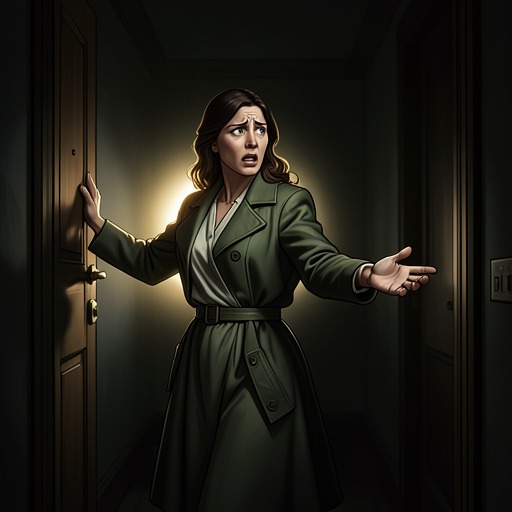
Sound provides an even more alarming proof. Chad and Daisy’s cries echo through a space that should not exist: no room in the house is longer than twenty-five feet, yet their voices answer themselves across distances of fifty feet and then fifty-six and a half feet. In the living room, Will finds the echoes issuing from a dark, doorless hallway that has appeared in the west wall. He enters without hesitation and returns carrying both children, each still clutching a homemade candle. Karen freezes at the threshold, unable to follow him into the darkness. The threshold thus divides not simply two rooms, but two incompatible states of reality: one in which the house remains domestic and one in which it has become an immeasurable interior.
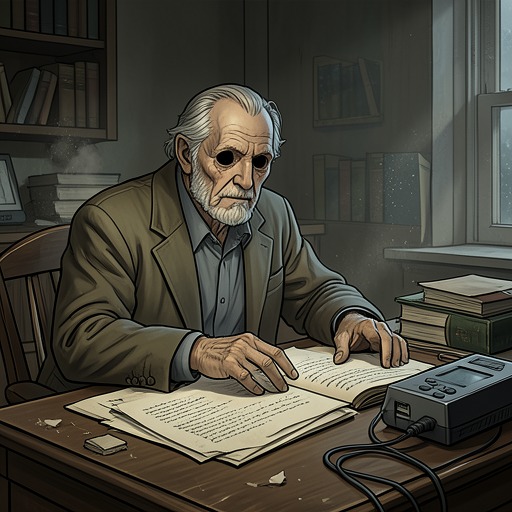
The labyrinth cannot be comprehended from an external overview because no one ever sees it in its entirety. Knowledge must be produced from within, by movement through spaces that resist a stable total map. The film shares this structure. Its edits lead viewers from one fragment to another, promising a center or solution while repeatedly opening onto further ambiguity. The experience of watching becomes structurally uncanny: the record permits wandering while preventing mastery, and the search for the whole returns the viewer to the instability of perception itself.
Repetition, Repression, and Familiar Emptiness
A later account connects the uncanny to Sigmund Freud’s theory of repetition compulsion. The unhomely appears when an inner tendency toward obsessive repetition overrides ordinary pleasure and makes something repressed recur. On this account, what seems foreign is not wholly new; it is something familiar and old-established that repression has estranged. The uncanny is consequently double: it is empty of knowledge while also saturated with the absence of knowledge, a condition in which repeated forms conceal what cannot be consciously understood.
The house makes this theory literal through its endless recurrence of corridors, hallways, rooms, and chambers. Its emptiness is not only a lack of furniture or inhabitants. It is described as lifeless, objectless, soulless, and even godless, an interior whose repeated architectural forms have been stripped of the human purposes that ordinarily make rooms meaningful. Familiarity becomes oppressive precisely because it repeats without yielding recognition. A hallway is recognizable as a hallway, but its recurrence no longer confirms home; it produces estrangement.
Change, Instability, and Significance
The house’s principal spaces exist for everyone, yet their dimensions and layouts may change. The Infinite Corridor, the Anteroom, the Great Hall, and the Spiral Staircase are shared features, but other areas never reliably reproduce the same pattern twice. This instability makes subjectivity a matter of degree: the architecture is not merely different for each observer, but variably available to observation and measurement. Even when a space is collectively witnessed, its form remains resistant to fixed description.
The uncanny therefore operates at the intersection of architecture, psychology, and narrative form. It converts a home into an alien environment without requiring a visible monster, and it converts measurement, direction, sound, and editing into sources of uncertainty. When Karen Green later returns to confront the living-room door, the expected corridor has vanished. The door opens onto a shallow closet with white walls, molding, and daylight, while the earlier black passage is absent. She laughs, but the laughter stops short: the disappearance removes the immediate reason for fear while also removing the reason to hope that Will Navidson can be found. The uncanny’s final irony is that safety and danger cannot be separated; the familiar can return only as another form of disorientation.